
Ranking high on Google isn’t about luck. It’s about building a blueprint that search engines can’t ignore. You need a strategy that turns raw data into a clear roadmap for your writers. Creating a content outline for seo writing is the most effective way to bridge the gap between a blank page and the first page of search results. We’ve seen too many brands waste thousands of dollars on beautiful prose that never gets discovered. They skip the planning phase. But you won’t. By the time you finish this guide, you’ll know exactly how to create seo content outlines that dominate the SERPs in 2026.
Why Is a Content Outline for SEO Writing Essential?
Most writers think they can just sit down and start typing. They’re wrong. Writing without a blog post outline template is like building a house without a foundation. It might look nice for a while, but it will eventually collapse under the weight of algorithm updates. A Reddit user recently shared a tip that consistently ranks them at number one. They said to always start with the outline before you even think about the first sentence. This step ensures your content has a purpose. It forces you to think about the reader’s journey.
The Difference Between Creative and Data-Driven SEO Writing
Creative writing relies on your gut feeling. It’s often beautiful. But Google doesn’t rank beauty. It ranks relevance. Data driven seo writing uses actual search metrics to decide what topics to cover. You look at what people are searching for. You check the competition. Then you build a structure that answers those needs. It’s a shift from what I want to say to what the user needs to hear. This approach guarantees that your seo content strategy is rooted in reality. It removes the guesswork from your automated content operation.
How Outlines Prevent Content Scope Creep
Scope creep kills rankings. You start writing about one thing and end up three miles away. This dilutes your topical authority. A content structure seo plan keeps you on track. It defines the boundaries of your article. If a point doesn’t fit the seo outline template, it doesn’t go in. You stay focused on your high-opportunity terms. This discipline makes your content more punchy. It makes it more useful. And it makes it much easier for Google to understand what your page is actually about.
How to Align Content Outlines With Search Intent?
Intent is the soul of SEO. If you don’t match it, you won’t rank. It’s that simple. You must understand why a user typed those specific words into the search bar. Are they looking for a quick answer? Do they want to buy something right now? Or are they just browsing for information? How to align content outlines with search intent starts with a deep dive into the four main categories of intent.
- Informational Intent: The user wants to learn something new or find a solution to a problem.
- Navigational Intent: The user is looking for a specific website or brand page.
- Transactional Intent: The user is ready to pull out their credit card and make a purchase.
- Commercial Intent: The user is comparing options before they decide to buy.
Identifying Primary User Problems via SERP Analysis
Open a private browser window. Type in your one keyword. Look at the top three results. These pages are your teachers. They tell you exactly what Google thinks the user wants. Are they all long-form guides? Are they short product pages? Look for the common themes. If every top result has a section on pricing, your seo content outline needs one too. This is real-time web research in action. It’s how you ensure your content that ranks actually meets the market’s expectations.
Choosing the Right Format Based on Intent
The format follows the intent. Don’t write a 5000-word guide for a transactional keyword. The user will just bounce. If the SERP is full of listicles, build a listicle. If it’s full of how-to videos, plan for heavy visual elements. Your editorial framework must be flexible. Structuring content for ranking means choosing the container that fits the liquid. You’re not just writing an article. You’re creating seo outlines that convert and rank by giving the user the exact experience they’re looking for.
What Is the Ideal Content Structure for SEO Success?
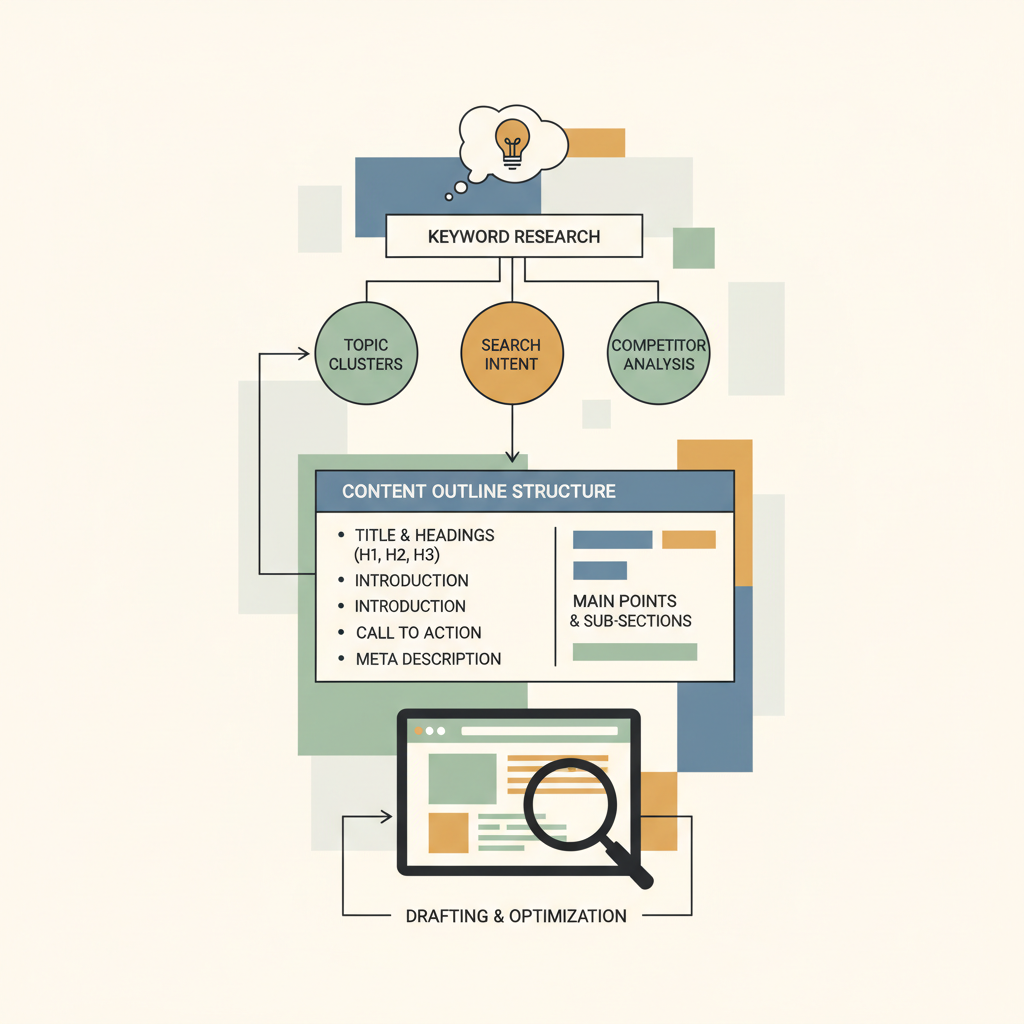
Structure is the skeleton of your content. Without it, your ideas are just a pile of mush. Google’s crawlers use your heading tags to understand the hierarchy of your information. They want to see a logical flow. They want to see that you’ve organized your thoughts. A solid content structure for seo makes it easy for both humans and bots to skim. It highlights the most important parts of your message. It builds trust.
Mastering the H1, H2, and H3 Structure for SEO
Your h1 h2 h3 structure for seo is a roadmap. The H1 is your destination. It should be unique and contain your primary keyword. Your H2s are the major milestones along the way. They break the topic into digestible chunks. H3s are the specific details within those chunks. Think of it like a book. The H1 is the title. The H2s are the chapters. The H3s are the sub-sections. Use this hierarchy to guide the reader through your long-form article. It keeps them engaged.
Optimizing Heading Syntax for Featured Snippets
You want Position Zero. It’s the holy grail of search. To get there, you need to write headers that Google can easily extract. Use question-based headers like What is an SEO outline? or How do I optimize it?. Follow these headers with a short, direct paragraph. Keep that answer between 40 and 50 words. This satisfies the algorithm’s need for quick facts. It’s a core part of content brief optimization. When you optimize it for snippets, you increase your click-through rate significantly.
How Do You Conduct Effective Competitor Content Analysis?
Don’t guess what works. Steal the logic from your competitors. Competitor content analysis is about finding the patterns of success in your niche. You aren’t looking to copy their words. You’re looking to understand their strategy. What topics do they cover? How do they structure their arguments? Where are they weak? This is a data-driven manufacturing process for high-quality content. It’s how you build something better than what already exists.
Evaluating Content Gaps in the Top 10 Search Results
Look for the holes. Read the top ten articles and ask what’s missing. Did they forget to mention a new 2026 trend? Is their advice too technical for a beginner? These gaps are your opportunities for Information Gain. Google loves content that adds something new to the conversation. If you just repeat what everyone else said, you’re a commodity. If you add a unique perspective, you’re an authority. This is the heart of a winning seo content strategy.
Measuring Word Count and Keyword Density Standards
Word count isn’t a ranking factor on its own. But it tells you how much depth is required. If the average top-ten result is 3000 words, don’t try to rank with 500. You need to match the keyword research depth of your peers. Use content scoring tools to see how often they use specific terms. Don’t obsess over exact percentages. Just ensure you’re in the same ballpark. It’s about being thorough without being repetitive. Balance is key here.
How to Map Keywords to a Content Outline Effectively?
Keywords are the bridges between your content and your customers. But you can’t just throw them at the page and hope they stick. You need a plan for how to map keywords to a content outline. This ensures that every term has a home. It prevents keyword research from feeling forced. You want your writing to feel natural. You want it to feel human. A well-mapped outline allows you to hit all your targets without sacrificing the reader’s experience.
Assigning Primary Keywords to the Most Important Sections
Your primary keyword belongs in the spotlight. Put it in your H1. Use it in your first H2. Make sure it appears in the first 100 words of your intent-driven hook. This signals to Google that this is the main topic. But don’t overdo it. One or two mentions in the key areas is enough. The rest of your seo content outline should focus on supporting that main idea. This is how you build content that ranks without looking like a spammer.
Distributing LSI and Latent Semantic Keywords
LSI keywords are the supporting actors. They provide context. If your main keyword is apple, your LSI terms might be fruit, orchard, or cider. These tell Google you’re talking about the food, not the tech company. Spread these naturally throughout your H3s and body text. Use your seo outline template to remind yourself where these terms fit best. This improves your semantic seo writing. It helps you rank for a wider variety of related searches.
What Elements Belong in a High-Performing SEO Outline Template?
A great outline is more than just a list of headers. It’s a complete set of instructions. It should give the writer everything they need to succeed. If the outline is vague, the content will be vague. We believe in providing a comprehensive blog post outline template every single time. This reduces the need for heavy editing later. It streamlines your automated content operation. It ensures consistency across your entire site.
- Target Audience: Who are we talking to?
- Primary Keyword: What is the main goal?
- Secondary Keywords: What else should we cover?
- Search Intent: Why is the user here?
- Internal Links: Where should we send them next?
- External Links: What sources do we trust?
Target Audience and Tone of Voice Specifications
You can’t talk to a CEO the same way you talk to a college student. Your outline must define the persona. Describe their pain points. List their goals. Set the tone of voice. Should it be professional? Should it be witty? This ensures the personality matches intent. It makes the reader feel like you’re talking directly to them. This connection is what drives conversions. It’s what turns a casual visitor into a loyal fan of your brand.
Internal and External Linking Strategies
Links are the connective tissue of the web. Your seo outline template should list specific pages to link to. Internal links help Google crawl your site. They also keep users on your page longer. External links to high-authority sources build your credibility. They show you’ve done your homework. Don’t just say add links. Give the writer the exact URLs. This level of detail is what separates a good outline from a great one. It’s essential for on-page seo checklist success.
Why Does Semantic SEO Writing Matter Most in 2026?
Google has moved beyond simple keyword matching. It now understands concepts. It understands the relationships between entities. This is semantic seo writing. It’s about covering a topic so thoroughly that Google views you as an expert. In 2026, this is the only way to stay relevant. You can’t just mention a keyword. You have to explain the whole ecosystem around it. You have to provide value that AI can’t easily replicate.
Covering Entities and Related Subtopics Fully
An entity is a thing or concept that is distinct and well-defined. Think of people, places, or ideas. Your content structure for seo should include all the entities related to your main topic. If you’re writing about how to create seo content outlines, you need to talk about search intent, keywords, and user experience. These are all related entities. Covering them fully satisfies the Helpful Content guidelines. It proves to Google that you know your stuff. It builds your topical authority.
Using Natural Language Processing (NLP) Tools for Outlining
NLP tools help you see the world the way Google does. They analyze thousands of pages to find the terms that appear most often. We use these tools to refine our seo content outline. They suggest subtopics we might have missed. They help us find the right balance of language. This isn’t about gaming the system. It’s about speaking the same language as the algorithm. It’s about being as clear as possible. One keyword. one click. one complete article. That’s the goal of a modern workflow.
How to Perform Data-Driven Content Brief Optimization?
Your outline isn’t finished until it’s optimized. Data-driven content brief optimization is the final polish. You take your rough structure and compare it against real-world metrics. You check it against your conversion goals. You make sure it’s built to perform. This step ensures that your long-form article doesn’t just get traffic. It ensures that the traffic actually does something. It turns your blog into a revenue generator.
Setting Clear Conversion Goals in the Outline
Every piece of content needs a job. What do you want the reader to do? Do you want them to sign up for a newsletter? Do you want them to buy a product? Put this goal in the seo outline template. Plan where the Call to Action (CTA) will go. Don’t just stick it at the bottom. Weave it into the narrative. Make it the logical next step for the reader. This is creating seo outlines that convert and rank at its best.
Incorporating Visual Assets and Media Requirements
Text isn’t enough anymore. Users want images. They want videos. They want infographics that explain complex ideas quickly. Your outline should specify where these assets go. Don’t leave it to chance. If an H3 section is particularly data-heavy, suggest a chart. If you’re explaining a process, suggest a video. This improves the mobile user experience. it keeps people on the page. And it gives you more opportunities to rank in image and video search results.
Which Free Tools Help Create SEO Content Outlines?
You don’t need a massive budget to build great outlines. There are plenty of free tools that provide incredible insights. You just need to know where to look. How to create an outline for free starts with the search engine itself. Google provides a wealth of data if you know how to read it. These tools are the foundation of any seo content strategy. They help you stay competitive without breaking the bank.
- Google Search Console: See what keywords you’re already ranking for.
- AnswerThePublic: Find the questions people are asking about your topic.
- Google Keyword Planner: Get search volume and competition data.
- Ahrefs Free Tools: Check backlink profiles and keyword difficulty.
Leveraging ‘People Also Ask’ for Subheadings
The ‘People Also Ask’ (PAA) box is a goldmine. It tells you exactly what questions your audience has. Take these questions and turn them into your H3 sections. This is the easiest way to ensure your content structure seo is relevant. It also helps you capture those PAA spots on the SERP. It’s a simple hack that yields massive results. We use this for every blog post outline template we create. It’s data driven seo writing in its simplest form.
Using Chrome Extensions for Competitor Header Extraction
There are several free Chrome extensions that let you see the heading structure of any page. Use them to audit the top-ranking articles for your keyword. Look at their H2s and H3s. Do you see a pattern? If three different competitors use the same subheading, you probably should too. This is a quick way to perform competitor content analysis. It saves you hours of manual work. It’s a must-have for any automated content operation.
What Are the Most Common SEO Outlining Mistakes to Avoid?
Even the best intentions can lead to bad results. We’ve seen many people make the same mistakes over and over. They get too focused on the technical side and forget the human side. Or they get too focused on the writing and forget the SEO. Avoiding these pitfalls is crucial for how to create seo content outlines that actually work. You need to find the middle ground. You need to be strategic and empathetic at the same time.
The Dangers of Keyword Stuffing in Headings
Don’t sacrifice readability for rankings. If your headers look like a list of keywords, you’ve failed. Google’s algorithms are smart enough to recognize keyword stuffing. It looks spammy to users. It looks suspicious to bots. Keep your headers natural. Use your primary keyword where it makes sense. But don’t force it. Your content structure for seo should always prioritize the reader’s experience. If it’s hard to read, it’s not going to rank.
Ignoring Mobile User Experience in Content Length
Most people will read your content on a phone. If your paragraphs are too long, they’ll look like a wall of text. If your long-form article is too dense, they’ll leave. Your outline should account for this. Plan for short sentences. Use bullet points. Break up the text with plenty of headers. This makes your content scannable. It makes it accessible. Structuring content for ranking in 2026 means thinking mobile-first. Always.
Checklist: Final Review Before Writing the Content
Before you hand the outline over to a writer, do one last check. This is your on-page seo checklist for the blueprint itself. It ensures that you haven’t missed any critical details. A few minutes of review now can save hours of rewrites later. We recommend going through this list for every single piece of content in your seo content strategy. It’s the final gatekeeper of quality.
- Keyword Coverage: Are the primary and secondary keywords included?
- Intent Alignment: Does the structure match the user’s goal?
- Header Hierarchy: Are the H1, H2, and H3 tags used correctly?
- Internal Links: Are there links to relevant pages on your site?
- Visuals: Are there placeholders for images or videos?
- CTA: Is there a clear next step for the reader?
Verifying Intent Alignment and Keyword Coverage
Does the outline actually answer the user’s question? If it doesn’t, go back to the drawing board. Check your keyword research one more time. Make sure you’ve mapped your terms to the right sections. This is the most important part of content brief optimization. If the intent is off, nothing else matters. You’re building content that ranks, and that requires absolute precision. Be ruthless with your own work.
Start Building Better SEO Outlines Today
Creating a content outline for seo writing is the single best thing you can do for your organic traffic. It gives you a clear path to success. It removes the uncertainty of the writing process. It ensures that every word you publish serves a purpose. We’ve shown you how to create seo content outlines that satisfy both Google and your readers. Now it’s time to put these principles into practice. Don’t just write. Plan.
The future of search is data-driven. It’s semantic. It’s focused on the user. By following this seo outline template, you’re positioning yourself ahead of the competition. You’re building a data-driven manufacturing process for your brand’s authority. Your seo content strategy deserves a solid foundation. Optimize it now. Start using our blog post outline template to see the difference in your rankings. Your journey to the top of the SERPs starts with a single, well-structured outline. Publishes directly to your CMS and watch your traffic grow. Reach out to us if you need help scaling your automated content operation. We’re here to help you win.